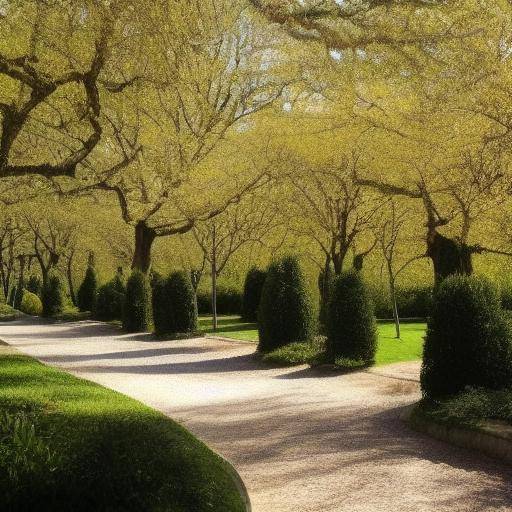
The Chinese gardens have been venerated for centuries by their beauty and mysticism, but few know the profound symbolism they enclose. In this article, we will explore the historical roots of Chinese gardens, their intrinsic symbolism and their influence on culture. From the serenity of lotus ponds to the hidden meaning behind the pavements, we will discover how these gardens go beyond their appearance to convey cultural and philosophical messages. Prepare to enter a world of meaning and beauty that transcends simple landscape.
Introduction
Chinese gardens are an artistic manifestation that combines nature with history, philosophy and culture. Through a careful arrangement of elements such as rocks, water, plants and architecture, these spaces manage to transmit deep symbolic messages. In this article, we will explore symbolism rooted in every corner of the Chinese gardens and how these elements convey values, beliefs and concepts that have endured over the centuries.
History and Background
The Chinese gardens have a rich and fascinating history dating back millennia. Its origins are at the intersection of philosophy, culture and nature. They emerged as a reflection of the Chinese worldview, where harmony and balance were fundamental values. From the first imperial gardens to contemporary creations, each stage has left a unique mark on the evolution of these spaces.
Origins and Meaning
The first Chinese gardens were based on Taoist and Confucian philosophy, where nature was seen as a reflection of the cosmic order and harmony in society. The layout of the elements in the garden, such as arched bridges, ponds and courtyards, was meant to reflect harmony and balance in the universe.
Evolution throughout the century
Throughout history, Chinese gardens have undergone significant changes. During the Song dynasty, elements such as pavilions and rocks were consolidated as symbols of status and refinement. During the Ming dynasty, the gardens reached their peak, with more elaborate and complex designs that symbolized metaphysical and religious concepts.
Influence in Art and Literature
The beauty of the Chinese gardens has inspired many artists and writers throughout the centuries. From poets who sought to capture the essence of the gardens in their verses to painters who reflected the serenity of these spaces in their works, the impact of the Chinese gardens transcended the physical limits to permeate art and literature.
The creations of these gardens symbolize a deep connection with nature and harmony with the environment that has been celebrated over the centuries.
Analysis in Deep
Philosophy and Symbolism
Chinese gardens are the product of a cosmovision rooted in Chinese philosophy. Each element, from the rocks to the winding paths, has a profound symbolic meaning. The rocks represent eternity and resistance, the water symbolizes fluidity and renewal, and the architectural structures reflect the search for harmony between humanity and nature.
Employment of Feng Shui
The feng shui, an ancient Chinese practice of harmonizing energies in the environment, has deeply influenced the design of the Chinese gardens. The principles of the feng shui are reflected in the disposition of the elements in the garden, seeking a harmony between the yin and the yang, as well as the fluid circulation of the chi, or vital energy.
Representation of Nature
A distinctive element of Chinese gardens is its ability to represent natural landscapes in a limited space, creating a sense of breadth and depth. The disposition of the elements seeks to evoke mountains, rivers and forests, giving the viewer the experience of being immersed in a natural environment, even in the middle of an urban center.
Comprehensive review
Contemporary applications
Today, Chinese gardens continue to be a source of inspiration and contemplation. His symbolism transcends cultural borders, and his influence is perceived in architecture, landscape design and spirituality. Even in non-Chinese environments, the design principles of these gardens apply to create spaces of serenity and harmony.
Best Practices and Recommendations
Interested in incorporating elements of the symbolism of the Chinese gardens in your own outdoor space? Consider the careful disposition of natural elements such as stones, water and vegetation, and seek to create a sense of balance and harmony. The subtle combination of the natural and the built can lead to a space that transcends the merely aesthetic to convey a deeper meaning.
Comparative analysis
Comparison with Other Gardening Traditions
Despite its distinctive symbolic elements, Chinese gardens share similarities with other gardening traditions, such as Japanese gardens and Zen gardens. However, each tradition has its own nuances and philosophical approaches, which is reflected in the disposition and meaning of the elements.
Practical Tips and Accessible Recommendations
- When designing a garden, reflect on the symbolism you want to convey and how the design elements can express that meaning.
- Do not underestimate the importance of balance and harmony; these fundamental values are manifested through the careful disposition of elements.
- Consider incorporating water elements, such as ponds or fountains, to represent fluidity and renewal in your garden.
Conclusions and FAQs
Chinese gardens enclose a fascinating symbolism that goes beyond its aesthetic appearance. Through carefully arranged elements, these spaces transmit messages of harmony, balance and connection with nature, offering a window to the rich Chinese worldview.
Frequently asked questions
- What is the importance of the disposition of the elements in the Chinese gardens?
- How does feng shui influence the design of Chinese gardens?
- What is the symbolism of the presence of water in the Chinese gardens?
- Is there significant differences between Chinese gardens and Japanese gardens in terms of symbolism?
- How can I incorporate Chinese symbolic elements into my own garden?
- What is the impact of Chinese gardens on contemporary culture and art?
In conclusion, Chinese gardens are much more than mere landscape compositions; they are carriers of a rich tradition of symbolism that continues to inspire and captivate people today.
This article is an invitation to immerse yourself in the fascinating intersection of nature, symbolism and culture, through the immortal Chinese gardens.